
- C. difficile spores sit at the top of the EPA's antimicrobial resistance hierarchy, making them the standard benchmark for evaluating disinfection efficacy.
- Manual disinfection has two structural problems: contact time is rarely observed in full, and spray-and-wipe cannot reach the surfaces where spores accumulate.
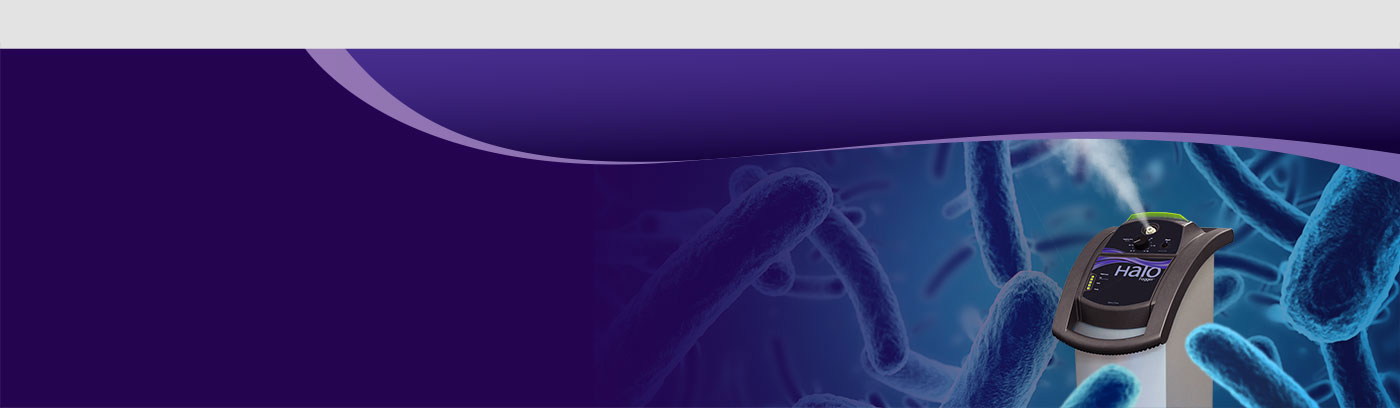
- The Halo Disinfection System delivers a dry mist that reaches all pre-cleaned, hard, non-porous surfaces in the room, including areas that wipes and sprays cannot access.
- HaloMist achieves 6-log sporicidal efficacy against C. difficile at 5% H₂O₂, lower than competing systems that require 7–8%, improving material compatibility with sensitive electronics.
C. difficile Prevention Starts With the Right Disinfection Standard
Clostridioides difficile is a preventable infection that sickens hundreds of thousands of Americans every year and can be deadly. Patients who acquire C. diff during a hospital stay are significantly more likely to experience severe complications or death compared to those who do not.
CDI rates are also a scored metric. The Leapfrog Group, CMS Care Compare, and U.S. News & World Report hospital rankings all factor healthcare-associated infection data into their evaluations, and the CMS Hospital-Acquired Conditions Reduction Program penalizes facilities in the bottom quartile for HAI performance with a 1% reduction in Medicare payments. A facility's C. difficile Standardized Infection Ratio is publicly reported and directly influences Leapfrog safety grades, which are increasingly used by patients, insurers, and employers when selecting care. Improving CDI rates is one of the most direct paths to improving those scores.
At Halosil NXT, we use Clostridioides difficile as a reference for efficacy because of its place on the microbial resistance hierarchy, a framework used to illustrate how difficult a pathogen is to kill through sanitization, disinfection, or sterilization. C. difficile is a spore-forming bacterium, which makes it particularly difficult to kill. Bacterial spores rank at the top of the resistance hierarchy. Because C. difficile demonstrates this extreme resistance, achieving efficacy against it tells us something important about what a disinfectant is capable of managing across a range of pathogens.
10-Year CDI Reduction Study — Pennsylvania Hospital, Penn Medicine
What does a decade of real-world data actually look like for the Halo Disinfection System? Researchers at Pennsylvania Hospital, Penn Medicine tracked CDI outcomes across ten years of use and published their findings in the American Journal of Infection Control. The results are worth reading in full.
Read the Full StudyWhy manual disinfection falls short
Disinfection requires two things: the right chemistry and comprehensive coverage. Manual disinfection struggles with both.
Contact time
Disinfectants require 3 to 10 minutes of dwell time depending on the product, but staff often work under room turnover pressure. The chemistry is rarely given enough time to work on every surface.
Unreachable surfaces
Spaces under equipment, behind furniture, inside cabinet handles, and in ceiling corners are beyond the reach of spray-and-wipe. C. difficile spores hide in exactly these places.
Staff variability
One shift may achieve thorough coverage; another cuts corners due to time pressure or staffing shortages. Manual disinfection depends entirely on individual execution, making reliability difficult to guarantee.
The Halosil NXT approach
The Halo Disinfection System delivers whole-room disinfection through aerosolized hydrogen peroxide fogging. HaloMist combines hydrogen peroxide and ionic silver. The hydrogen peroxide oxidizes bacterial cell structures and breaks down to water and oxygen. The silver interferes with bacterial energy production and disrupts proteins. This combination achieves 6-log sporicidal efficacy against C. difficile and is effective against a broad spectrum of healthcare-associated pathogens on hard, non-porous surfaces.
The delivery method addresses what manual disinfection cannot. The HaloFogger aerosolizes HaloMist into a fine dry mist that reaches under equipment, into crevices, and across hard, non-porous surfaces simultaneously. Coverage is comprehensive because the mist penetrates spaces a wipe cannot access.
Consistency is built in. The same device, the same chemistry, the same contact time: every application performs the same way, regardless of staff variability or time pressure.
The chemistry is efficient. By combining hydrogen peroxide with ionic silver, Halosil achieves 6-log sporicidal efficacy against C. difficile using 5% hydrogen peroxide, lower than competing systems that use 7–8% or higher. Lower concentration means better material compatibility with sensitive electronics and reduced cost over time.
*Independent testing confirmed HaloMist leaves no detectable silver residue when applied correctly.
Frequently asked questions
Quick answers on C. difficile efficacy, multi-room use, and HaloMist chemistry.
-
Because C. difficile is a spore-forming bacterium at the top of the microbial resistance hierarchy. Achieving efficacy against it demonstrates what a disinfectant is capable of managing against particularly difficult pathogens. That's why we highlight C. difficile performance: it tells you something important about the disinfectant's capability across a broad range of organisms.
-
Yes. The HaloPortal accessory allows a single HaloFogger to treat multiple adjacent rooms sequentially, improving productivity for high-turnover units.
-
No. Independent testing confirmed HaloMist leaves no detectable silver residue when applied correctly. Hydrogen peroxide breaks down completely to water and oxygen.
Ready to strengthen your infection prevention strategy?
Contact Halosil NXT to learn more about the Halo Disinfection System and how whole-room disinfection fits your facility's protocols.