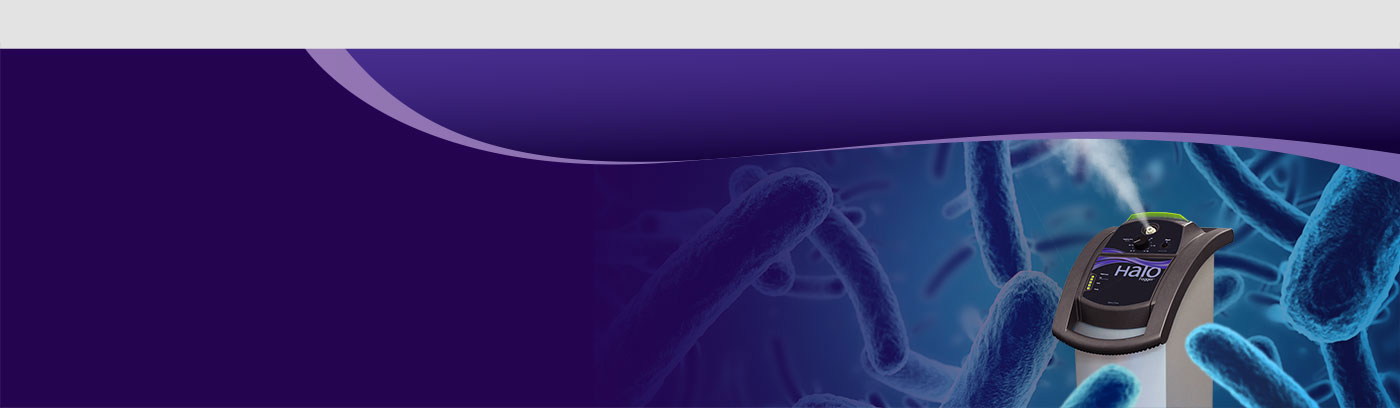

A clinical and practical guide to whole-room aerosolized hydrogen peroxide disinfection: how 6-log sporicidal performance works, what the published evidence shows for CDI rate reduction, and how the HaloFogger fits into real healthcare workflows.
- C. difficile spores set the benchmark for disinfection because they are the most resistant pathogens in the EPA's antimicrobial hierarchy.
- A 6-log kill claim means 99.9999% reduction, the highest level available for a surface disinfectant outside of sterilization.
- A 10-year peer-reviewed study documented a 74% reduction in hospital-onset CDI following sustained use of the Halo Disinfection System. (Truitt et al., AJIC 2021)
- HaloMist achieves 6-log sporicidal efficacy at 5% H₂O₂, lower than most competing systems, which improves material compatibility with sensitive electronics.
Why C. difficile sets the standard for disinfection
Clostridium difficile is a bacterial pathogen responsible for approximately 500,000 healthcare-associated infections annually in the United States, along with roughly 29,000 deaths. It is not the most common healthcare-associated infection, but it is among the most difficult to eliminate, which is why infection control professionals use it as the benchmark for evaluating disinfection protocols.
The difficulty comes down to its biology. Under environmental stress, C. diff forms spores: dormant, highly protective structures that allow it to persist on hard surfaces for months. Standard disinfectants that kill vegetative bacteria often fail against spores entirely. Alcohol-based hand sanitizers, for instance, have no meaningful sporicidal activity. Most quaternary ammonium compounds, the most widely used category of surface disinfectants in healthcare, are similarly ineffective against C. diff spores. The CDC classifies CDI as an Urgent Threat and, together with The Joint Commission, estimates associated costs exceed $6.3 billion annually in the United States.
A disinfectant that achieves validated sporicidal kill against C. difficile spores is validated against the most resistant organism in the EPA's antimicrobial hierarchy. Every pathogen below it, including MRSA, Pseudomonas aeruginosa, influenza, and norovirus, falls within that performance envelope.
Studies cited in the peer-reviewed literature found that C. difficile can be recovered from patient rooms 29% of the time when the occupant is an asymptomatic carrier, and from 49% to 100% of rooms occupied by patients with active CDI. Patients admitted to a room in which a prior occupant had CDI face meaningfully higher acquisition risk, even after standard terminal cleaning has been performed. That gap is what whole-room disinfection systems are designed to close.
What "6-log kill" actually means in practice
A log reduction describes how much of a pathogen is eliminated during a disinfection cycle. Each log represents a 10-fold decrease in surviving organisms. The difference between levels looks like this:
| Log reduction | % eliminated | Surviving organisms (starting from 1 million) | Classification |
|---|---|---|---|
| 3-log | 99.9% | 1,000 surviving | Sanitizer threshold |
| 4-log | 99.99% | 100 surviving | Disinfectant (general) |
| 5-log | 99.999% | 10 surviving | High-level disinfection |
| 6-log | 99.9999% | 1 surviving | Sporicidal, top of EPA hierarchy |
For C. difficile spores specifically, 6-log sporicidal performance is the highest kill level documented for a surface disinfectant short of sterilization. That final decimal place matters considerably: in a room with millions of pathogen cells, the difference between 99.9% and 99.9999% elimination is the difference between thousands of surviving organisms and near-zero. For a pathogen with a low infectious dose that spreads readily in high-acuity environments, that gap has clinical consequences.
Not all whole-room disinfection systems achieve 6-log sporicidal kill. Many achieve 3- to 4-log reductions, which satisfies general sanitization standards but leaves a meaningful performance gap for sporicidal applications in CDI-risk environments.
Does whole-room hydrogen peroxide fogging reduce CDI rates in practice?
There is published data to answer this question directly.
A 10-year retrospective study at Pennsylvania Hospital, Penn Medicine, a 475-bed acute care urban teaching hospital in Philadelphia, examined CDI rates before and after implementation of the Halo Disinfection System, an aerosolized hydrogen peroxide (aHP) whole-room fogging system. The study was structured in two phases: a before-and-after comparison spanning 60 months, followed by an additional 60-month period of continued aHP use. It was authored by Dr. Christopher L. Truitt and colleagues and published in the American Journal of Infection Control in 2021.
All CDI cases were tracked using National Healthcare Safety Network (NHSN) criteria. Fogging compliance exceeded 90% year over year throughout the study. Rooms were also disinfected daily with a 10% bleach solution as part of the existing cleaning protocol, and cleaning effectiveness was monitored through a fluorescent gel program and later an ATP monitoring process.
Before implementation: 120 HA-CDI cases over 262,656 patient days, a rate of 4.6 per 10,000 patient days. After implementation: 72 HA-CDI cases over 262,106 patient days, a rate of 2.7 per 10,000 patient days (P < .001). Continued use through 2019 further reduced HO-CDI to 1.4 per 10,000 patient days, with an SIR of 0.30 (P < .0001).
Truitt CL, Runyan DA, Stern JJ, Tobin C, Goldwater W, Madsen R. American Journal of Infection Control. 2021.A single-site retrospective study cannot establish direct cause-and-effect, and the authors note that potential confounders, including antibiotic usage patterns, patient demographics, and hand hygiene compliance, were not independently controlled throughout the full study period. That said, no new major infection control initiatives were introduced during the study periods, aHP compliance was consistently documented above 90%, and the effect was sustained across a full decade of data. The full white paper is available for download using the button at the bottom of this article.
Why manual disinfection leaves gaps that whole-room fogging closes
This is not a criticism of EVS staff. It is a geometry problem inherent to how manual disinfection works.
Manual wipes require direct, deliberate surface contact on every square inch of every surface in a room, on every shift, during every turnover. The surfaces that matter most are often the ones most easily skipped: behind monitors and IV pumps, along baseboards and curtain tracks, in seam lines between cabinets and walls, under bed frames, and along the back edges of high-touch equipment. UV-C light systems have a different limitation: they work only in the direct path of the light source, and cast shadows wherever that path is interrupted by room geometry, equipment, furniture, or curtain folds.
Dry mist fogging addresses both problems. The HaloFogger uses a unidirectional charged-particle nozzle to generate droplets approximately 10 microns in diameter, which fill the room volume and disinfect all pre-cleaned, exposed hard, non-porous surfaces, including the areas wipes and sprays cannot reliably reach. As the EPA label states: "Goes above, beyond, under and around disinfecting sprays and wipes."
Surfaces must be pre-cleaned of visible organic material (blood, body fluids, biofilm) before a fogging cycle. Organic load can interfere with disinfectant efficacy. The HaloFogger is a terminal or enhanced disinfection step that follows standard manual cleaning protocols.
How silver-stabilized hydrogen peroxide compares to standard H₂O₂ disinfectants
Not all hydrogen peroxide disinfectants perform the same way, and the chemistry behind HaloMist explains why a lower concentration can deliver equivalent sporicidal results.
HaloMist is formulated with 5.0% hydrogen peroxide stabilized with 0.01% ionic silver (derived from silver nitrate). The ionic silver contributes in two ways. First, it stabilizes the hydrogen peroxide, extending its active period during the disinfection cycle so the formula remains effective across the full treatment duration. Second, it contributes additional antimicrobial action through multiple mechanisms: disrupting cell membranes, inhibiting enzyme function, and interfering with DNA replication. This multi-mechanism approach is why the formula achieves 6-log sporicidal efficacy at a lower H₂O₂ concentration than competing systems require.
That concentration difference has real consequences in healthcare environments, where sensitive electronics such as monitors, infusion pumps, and ventilators are present in nearly every patient room and cannot realistically be removed before a disinfection cycle. HaloMist requires no rinsing after application and leaves no detectable residue when used according to label directions. After the cycle, hydrogen peroxide breaks down to water and oxygen.
What pathogens the Halo Disinfection System is registered to kill
When used in the HaloFogger, HaloMist carries EPA registration (Reg. #84526-6) for the following pathogen claims on hard, non-porous surfaces:
-
Clostridium difficile spores (ATCC #43598)
Kills 99.9999% of C. difficile spores. This 6-log sporicidal efficacy is the highest kill level available for a surface disinfectant, and C. diff spores sit at the top of the EPA's antimicrobial resistance hierarchy.
-
Pseudomonas aeruginosa (ATCC #15442)
Common in ICUs and associated with ventilator-associated pneumonia, wound infections, and urinary tract infections. Increasingly antibiotic-resistant in clinical settings.
-
Staphylococcus aureus (ATCC 6538)
A leading cause of surgical site infections and bloodstream infections. The EPA label covers both standard and methicillin-resistant strains (MRSA) for the sprayer application.
All three pathogens are primary contributors to hospital-acquired infections in acute care settings, and all three accumulate on the hard, non-porous surfaces that whole-room fogging is designed to address. The system is registered for use across the full range of healthcare environments: patient rooms, ICUs, operating suites, isolation areas, emergency departments, neonatal units, dialysis clinics, long-term care facilities, pharmacies, and more.
How the HaloFogger fits into real healthcare workflows
A disinfection system's value depends on whether staff will use it consistently. Room turnover pressure is real, and any protocol that adds significant complexity (special mixing, PPE changes, complicated setup) creates the conditions for inconsistent adoption. The Pennsylvania Hospital study maintained 90%+ fogging compliance year over year for a decade. That outcome requires a system that is genuinely operable within the existing workflow.
-
Pre-clean the room
Clean all surfaces with your standard cleaning protocol first. All hard, non-porous surfaces must be visibly clean before fogging. Organic load can interfere with disinfectant efficacy.
-
Prepare the room
Open the bathroom door and partially open privacy curtains so the dry mist can reach those surfaces. Seal HVAC vents with plastic covers and place a towel at the base of the main door.
-
Position and initiate
Place the HaloFogger in the far corner of the room facing inward. No mixing or dilution is required. Initiate the cycle and exit. Staff do not remain in the room during disinfection.
-
Allow passive decomposition
Hydrogen peroxide breaks down passively to water and oxygen. No additional aeration or scrubbing time is required after H₂O₂ levels fall to 0.2 ppm or below.
-
Confirm re-entry
The room is safe to re-enter once H₂O₂ levels are at or below 0.2 ppm (the OSHA permissible exposure limit). The HaloSense hydrogen peroxide detector can be used to confirm re-entry readiness.
For facilities with high room turnover or isolation units, the HaloFogger FLX paired with the HaloPortal offers an additional operational option. The HaloPortal is a permanent through-the-wall connection that allows staff to initiate disinfection cycles from outside the treated room, eliminating the need to enter a contaminated space or change PPE between cycles. A single HaloFogger can treat multiple rooms in succession from a fixed installation point, a meaningful efficiency gain where room availability directly affects patient throughput.
The financial case for whole-room disinfection
Approximately 25% of U.S. hospitals are currently penalized under the CMS Hospital-Acquired Conditions Reduction Program, losing 1% of Medicare payments annually for HAI-related performance deficiencies. For an average acute care hospital, that is roughly $328,800 per year. CDI also extends average inpatient length of stay, ties up beds, and affects the publicly reported metrics that Leapfrog, U.S. News, and CMS Care Compare use to grade facilities, all of which influence patient volume over time.
Acquisition price
Priced approximately 30% below comparable 6-log, EPA-validated whole-room disinfection systems, with most routine maintenance performable by facility staff.
Section 179 eligibility
Depending on the size of your organization, this system may qualify for Section 179 tax treatment, allowing facilities to deduct a portion of the equipment purchase price.
CMS and Leapfrog exposure
CDI Standardized Infection Ratios are publicly reported metrics used by Leapfrog, U.S. News, and CMS Care Compare. A facility that moves from a C to a B safety grade can trace part of that improvement to measurable reductions in its reported SIR.
Frequently asked questions
Questions infection preventionists and EVS directors ask most about whole-room hydrogen peroxide disinfection and the Halo Disinfection System.
-
C. difficile forms spores that persist on hard surfaces for months and resist alcohol-based sanitizers and most quaternary ammonium disinfectants. Because spores are the most resistant form of microorganism per the EPA's antimicrobial hierarchy, a disinfectant that achieves validated sporicidal kill against C. diff spores is validated against the hardest target available. Every pathogen below it, including MRSA, Pseudomonas, influenza, and norovirus, falls within that performance envelope. The CDC classifies CDI as an Urgent Threat and estimates associated costs exceed $6.3 billion annually in the United States.
-
A 6-log reduction means the disinfectant kills 99.9999% of the target organism under the tested conditions. Each log represents a 10-fold decrease in surviving organisms: 3-log is 99.9%, 4-log is 99.99%, 5-log is 99.999%, and 6-log is 99.9999%. In a room with millions of pathogen cells, that final decimal place represents the difference between thousands of surviving organisms and near-zero. For C. difficile spores, 6-log sporicidal performance is the highest kill level documented for a surface disinfectant short of sterilization, and it sits at the top of the EPA's antimicrobial efficacy classification.
-
A 10-year retrospective study at Pennsylvania Hospital, Penn Medicine documented CDI rates declining from 4.6 to 2.7 per 10,000 patient days after initial implementation of the Halo Disinfection System (a 41% reduction, P < .001), then further to 1.4 per 10,000 patient days over five additional years of continued use (a 74% reduction, P < .0001). The Standardized Infection Ratio fell from 0.77 in 2015 to 0.30 in 2019, remaining consistently below the national benchmark of 1.0 throughout. (Truitt et al., American Journal of Infection Control, 2021)
-
No. Surfaces must be pre-cleaned before a fogging cycle. Organic material, including blood, body fluids, and biofilm, can interfere with disinfectant efficacy, and the HaloFogger does not remove gross contamination. The system is designed to work as a terminal or enhanced disinfection step after standard manual cleaning protocols. At Pennsylvania Hospital, it was added on top of an existing daily 10% bleach protocol. The fogger was not a replacement for that step.
-
HaloMist is formulated with 5.0% hydrogen peroxide and 0.01% ionic silver (from silver nitrate). The ionic silver extends the active period of the hydrogen peroxide during the cycle and contributes additional antimicrobial action through multiple mechanisms: disrupting cell membranes, inhibiting enzyme function, and interfering with DNA replication. The combined effect allows 6-log sporicidal efficacy at a lower H₂O₂ concentration than most competing systems require. Competing EPA-validated whole-room systems typically use 7–8% hydrogen peroxide for comparable sporicidal performance, which presents a greater risk to sensitive electronics (monitors, infusion pumps, ventilators) that cannot easily be removed from patient rooms before a disinfection cycle.
-
Yes, when the HaloFogger is paired with the HaloPortal. The HaloPortal is a permanent through-the-wall connection that allows staff to initiate and complete disinfection cycles from outside the room, eliminating the need to enter a contaminated space or change PPE between cycles. A single HaloFogger can treat multiple rooms in succession from a fixed installation point, an efficiency gain in surgical centers or isolation units where room availability affects patient throughput.
-
Yes. HaloMist is EPA-registered (Reg. #84526-6) with sporicidal claims against Clostridium difficile spores on hard, non-porous surfaces, validated through the EPA's Antimicrobial Testing Program. The system is registered for use across a wide range of healthcare settings, including acute care hospitals, ICUs, isolation rooms, operating rooms, emergency departments, neonatal units, and long-term care facilities.
-
Approximately 25% of U.S. hospitals are penalized under the CMS Hospital-Acquired Conditions Reduction Program, losing 1% of Medicare payments annually for HAI performance deficiencies. CDI also extends average inpatient length of stay and affects Leapfrog, U.S. News, and CMS Care Compare scores, all of which affect patient volume over time. The Halo Disinfection System is priced approximately 30% below comparable 6-log, EPA-validated systems and qualifies for Section 179 tax treatment, allowing facilities to deduct the full purchase price in the year of acquisition.
Ready to see what the evidence looks like for your facility?
Our infection prevention specialists can walk you through the published data, help you evaluate fit with your current protocols, and arrange a demonstration for your team.