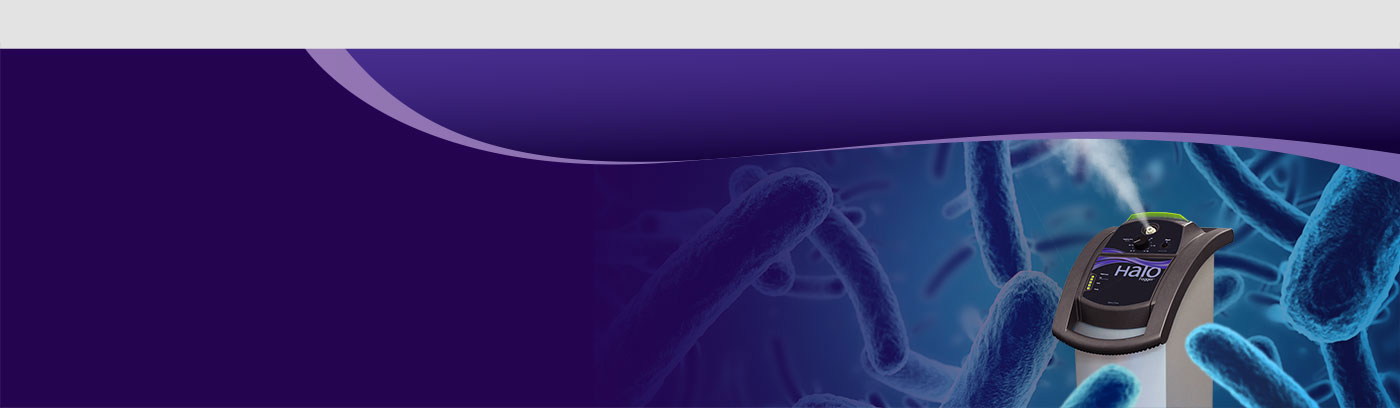
Timely insights on whole room disinfection.
BlogJune 18, 2024
Advantages of H2O2 Foggers

What Are the Advantages of Hydrogen Peroxide Foggers?
Whole-room disinfection comes down to three questions: Does the solution actually kill the pathogens you’re up against? Can your team use it without extensive training or equipment? And does the cost make sense over time? For facilities evaluating fogging systems, those questions don’t always get straightforward answers. The HaloFogger line was designed to address all three.
At the center of the system is HaloMist Disinfectant, a silver-stabilized hydrogen peroxide formula. The silver component stabilizes the H₂O₂, which allows HaloMist to achieve EPA-validated 6-log sporicidal efficacy at a 5% hydrogen peroxide concentration. Competing systems typically require 7% or higher to reach comparable performance. That concentration difference matters in practice: lower H₂O₂ means better material compatibility with sensitive electronics and equipment found in healthcare, veterinary, and biomedical environments.
Fogging itself is sometimes misunderstood. This isn’t a dense, wet cloud. The HaloFogger’s advanced nozzle produces a dry mist fine enough to spread evenly across a room, reaching surfaces that sprays and wipes physically cannot access: behind equipment, inside HVAC returns, along baseboards, into the nooks and crannies where pathogens accumulate. The mist settles on hard, non-porous surfaces and disinfects them, then breaks down into water and oxygen, leaving no detectable residue.
The Benefits of Whole-Room Fogging Disinfection
Ease of Use. The HaloFogger system requires no mixing, no dilution, and no specialized labor. HaloMist is a ready-to-use formula. Staff set up the device, initiate the cycle, and the system runs. Once hydrogen peroxide levels drop below 0.2 ppm, the room is safe to re-enter. That kind of simplicity reduces both training burden and the variability that comes with manual disinfection protocols.
Material Compatibility. Because HaloMist achieves high-level disinfection at lower H₂O₂ concentrations than many competing systems, it has broader compatibility with the types of equipment and surfaces common in healthcare and biomedical settings. This is a practical advantage in environments where equipment replacement is expensive and downtime is not an option.
Coverage. Manual wiping leaves gaps. UV systems require line-of-sight. Dry mist fogging disinfects hard-to-reach hard, non-porous surfaces throughout the treated room, including high-touch surfaces and areas that are difficult or time-consuming to reach manually. For whole-room disinfection, that coverage consistency is the point.
HaloFogger Models
Not every space has the same requirements, and the HaloFogger line reflects that.
The HaloFogger STD is the baseline model for reliable whole-room disinfection in standard-sized rooms. The HaloFogger FLX is designed for situations requiring more precise nozzle placement or rapid succession fogging across multiple spaces. The HaloFogger EXT is suited for smaller areas where a compact footprint matters.
Each model is capable of treating rooms up to 3,663.7 cubic feet (104 m³) and can be configured to treat multiple spaces simultaneously, making the system scalable across facilities of different sizes and layouts.
Where the HaloFogger Works
The system is EPA-registered for use across a wide range of environments: hospital patient rooms, operating suites, ICUs, veterinary clinics, biomedical and biosafety laboratories, pharmaceutical facilities, dental offices, long-term care facilities, and more. Wherever a facility needs documented, repeatable whole-room disinfection on hard, non-porous surfaces, the HaloFogger is built for the job.
Confidence: Brought to You by Halosil NXT.